

Kilsture 1000 - a citizen science challenge in the forest
Updated: Jan 7

When we launched Kilsture1000 in April this year, our aim was simple: Could we find 139 as yet unrecorded species in Kilsture Forest, taking us from a total of 861 species recorded by the end of 2024 to our target of 1000? We were lucky enough to have exceptional Elaine Rainey to manage the project whose passion, expertise and knowledge inspired us all to deepen our understanding of the forest.

All data on Kilsture wildlife is held by South West Scotland Environmental Information Centre who have been closely involved in our citizen science programme from the start - see this blog roll. To help us focus efforts for Kilsture1000 they identified gaps in the data they have for Kilsture, and Elaine built a programme of 16 specialist-led events designed to target specific under-recorded species and deepen our knowledge of the site’s biodiversity. What followed was an exciting and rewarding example of citizen science working really well – attracting both specialists and amateurs to the challenge, yielding really important scientific data. The following account is based on highlights from notes that Elaine took over the course of this programme.
Working with Iain Leach, Bee Positive DG8, and local volunteers, we hosted two moth-ID workshops and ran monthly trapping sessions.

The results were extraordinary:
277 species of moth recorded in Kilsture
Including several headline finds:
Orange Footman – a southern species spreading northwards, and only the second record for Dumfries & Galloway.

Grey Shoulder-knot & Acleris literana – both likely first records for Wigtownshire.


Scorched Carpet and Barred Hook-tip – species considered local or scarce in Scotland.
These moths don’t just tell us what’s present. They indicate shifting climate trends, habitat quality, and ecological continuity—giving us a deeper understanding of how the forest is changing.


Bryophytes:
A highlight of Kilsture1000 was welcoming Dr Elizabeth Kungu, a national bryophyte expert, along with a team of students. As Bryophytes are very hard to identify, it was only possible for specialists to carry out the survey.
Before this project, the forest had last been surveyed for mosses and liverworts back in 2012—and only lightly at that.

48 mosses and 17 liverworts recorded
Among them was a true highlight:
Path Beardmoss – a new Vice County Record for Wigtownshire
This species only entered the British flora in 2021 and is otherwise known from tropical and subtropical parts of Central & South America, Sub-Saharan Africa, and a small number of Atlantic islands (Portugal, Madeira, Canary Islands). Its presence in Kilsture is both unexpected and hugely significant.
What these surveys taught us
Having expert eyes on the ground helped us understand how Kilsture’s structure and hydrology shape its bryophyte communities:
Deep ditches and upturned root plates from fallen trees create perfect moist niches.
Wetlands and ponds produce domes of humid air that support mosses and liverworts, especially on overhanging branches.
This holistic picture will help guide future habitat management.
Lichens:
Thanks to members of the British Lichen Society, we were able to add 40 species of lichen


Kilsture proved to be a particularly good site for species. However, the surveys also highlighted constraints: the forest’s low light levels and even-aged structure limit lichen diversity.Some selective canopy opening would likely increase both species richness and structural variety—something echoed by botanist Mike Jeeves during his work with flowering plants.
Great Crested Newts (GCN)

With known populations nearby, we carried out eDNA sampling at two sites.

One of the two ponds tested positive for GCN.
There is clear scope for:
further sampling (April–June window)
habitat enhancement of wetland areas, following proper protections and expert guidance
Glow-worms
Historic records from the 1990s suggested glow-worms might be present, and there are current records nearby. Two surveys returned no sightings, but dry spring conditions can severely affect larvae through desiccation.

We'll repeat transects next year and add new routes—especially along long grass, woodland edges and path margins.
Mammals:
Our mammal discoveries were boosted by the Scottish Badgers Galloway Branch, who updated all existing Forestry and Land Scotland badger records and placed monitoring cameras across the forest.

The cameras also provided something we were thrilled to confirm the sighting of a Red Squirrel in Kilsture. This was particularly welcome given the rising number of Grey Squirrel reports in the region.

The Final Count: How did we do?
At the beginning of 2024, the species list for Kilsture stood at 861 species
After four months of community science, expert-led surveys, guided walks, workshops, trapping sessions, and thousands of volunteer hours, we reached the end of the Kilsture1000 project with:
1,331 species recorded in Kilsture Forest
That’s 470 new species added!
Table below shows largest groups:
Moths: 391
Flowering plants: 285
Fungi: 243
Birds: 85
Mosses: 66
Beetles: 44
Lichens: 44
There are still many gaps - no spiders for example and at the end of Kilsture1000 no small mammals had been recorded. But, thanks to our Forest School students, the first record for a woodmouse has now been submitted - they captured one on their monitoring camera in October.
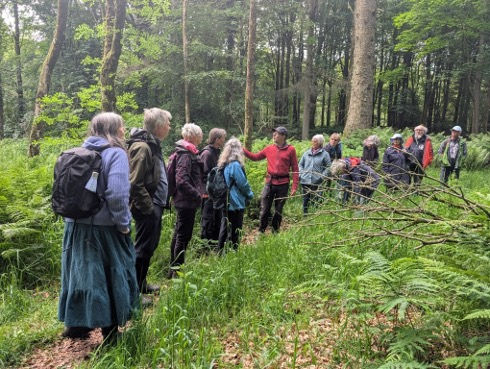
But the story doesn’t end there. Species numbers show diversity, but biological records show continuity—how often species are seen and how present they remain over time.
At the end of 2024, Kilsture had:
2,351 biological records
By the end of Kilsture1000, that number had grown to 5,082 biological records
An increase of 2,731 records.
Kilsture1000 has been transformational. Not just in terms of numbers, but in what we’ve learned about the forest ecosystem—and how many people helped uncover its hidden richness. Thanks to everyone who took part in the challenge!


Comments